Go sober this October: How to lower your alcohol intake this month
Last week I was interviewed by the Daily Telegraph about this year’s ‘Go Sober For October‘ (“Octsober”) campaign. In addition to wanting some tips on how to cut down alcohol intake (see below), they wanted to know why people are so reliant on alcohol to relieve stress, socialise and escape. On a very simple level, alcohol is a pharmacological depressant that enhances disinhibition (i.e., a disregard for social conventions) and which is both physiologically and psychologically rewarding. Like most addictive behaviours it is a mood modifier that can either get individuals high, excited, buzzed up and aroused or (somewhat paradoxically) do the exact opposite and help them escape, numb, relax and de-stress. The fact that it’s socially condoned and widely available make it a perfect substance for individuals to use and misuse.

The remainder of today’s blog provides some tips on the simplest ways to cut down on alcohol intake. They are not aimed at problem drinkers as they require extra external support and interventions from family, friends, doctors and/or therapists. The tips below come from a variety of sources (listed in ‘Further reading’). I don’t claim to be an expert on alcohol addiction (although I have published more than a few papers on alcohol problems over the years – again, see some of these in ‘Further reading’ below) but most of these tips are practical and common sense:
Don’t go it alone: If you really want to cut down your alcohol intake, try do it with your friends and family together. Doing it with others rather than on your own means you will have others around you going through the same thing as yourself as well as having a ready made support group.
Don’t buy rounds of drinks in pubs and clubs: If you’ve ever been out on a pub crawl with friends, you will know that you tend to drink at the pace of the quickest drinker in the group (and this may be at a quicker rate than you would ideally prefer). If you do want to drink in rounds, then try opting out every other round and/or try to drink with a smaller group of friends (as larger groups typically lead to more alcohol being drunk over the course of an evening).
Spread out your drinking and drink more slowly: Sounds obvious but it’s true. (As I noted above, in places where alcohol is very expensive this becomes a natural option). A related option is to have one alcoholic drink followed by one non-alcoholic drink throughout the evening.
Don’t buy pints, doubles or large glass drinks: When you do drink in pubs and clubs, order smaller measures (wine in a small glass rather than a large one, halves instead of pints, a bottle of lager rather than a pint of lager). All of these smaller options mean a reduced ‘alcohol by volume’ ratio (i.e., less alcohol actually consumed). If you are the kind of person who says to yourself ‘I never have more than two glasses of wine a night’, then changing to a smaller glass will have an immediate and appreciable effect in lowering overall alcohol intake.
Where possible choose non–alcoholic drinks: When you eat out or dine at home, have a soft drink, juice or water rather than wine or beer with your meal.
Dilute alcoholic drinks: If the option of a non-alcoholic drink isn’t always possible or simple doesn’t appeal, then dilute your drinks. Have a lager shandy or a white wine spritzer.
Have ‘alcohol-free’ days: If you drink every day, start by trying to drink alcohol every other day. If you drink alcohol a few times a week, try to drink just once a week. Just cutting down on your normal weekly pattern will help you to realise that you can go without alcohol.
Avoid cocktails: Cocktails often contains a lot more alcohol than people think.
Drink alcohol free beers and lagers: If you love the taste of lager or beer, there are alcohol free options. There are also an increasing number of fake cocktails (‘mocktails’).
Reward yourself for not drinking alcohol: Many people drink as a way to alleviate the stresses and strains of every day life (or to do the exact opposite – to celebrate the fact that you’ve done something well or because it is a special occasion). The money not spent on alcohol could go towards giving yourself another kind of treat or reward (a massage, the new CD you wanted, watching a film at the cinema, etc.).
Tell everyone in your social circle you’re cutting down alcohol intake: By telling everyone you know including family, friends and work colleagues, you will be more committed to not drinking alcohol than if you told no-one.
Avoid temptation: One of the key factors in any potentially addictive activity is knowing what the ‘triggers’ are (e.g., walking past a pub, watching television, having an argument with your loved one, etc.). Knowing what the triggers are can be a strategy for avoiding temptation (e.g., changing the routes on your way back home to avoid walking past your favourite pub, doing something else instead of watching television, etc.).
Get a new hobby: Changing one aspect of your routine life can also help change other aspects. Sometimes, changing one aspect of your life (such as introducing daily exercise) goes hand-in-hand with other areas of your life (drinking less alcohol, eating more healthily).
Think of the benefits of not drinking alcohol: Not drinking alcohol can bring lots of positives. In six months without alcohol I’ve lost about 6.35kg in weight because alcohol is high in calories (and that’s without exercise!). Other benefits include more money for other things, better quality sleep, less stress (because alcohol is a depressant), and better health.
Use alcohol tracking tools: Many apps are now available to help you keep track of your alcohol intake. For instance, the MyDrinkaware tool allows you to see how alcohol is affecting you on a number of different dimensions including your health (how many units you are consuming over time), weight (how many calories you are consuming over time), and finances (how much money you are spending on alcohol over time).
Dr. Mark Griffiths, Professor of Behavioural Addiction, International Gaming Research Unit, Nottingham Trent University, Nottingham, UK
Further reading
Drinkaware (2015). Tips for cutting down when out. Located at: https://www.drinkaware.co.uk/make-a-change/how-to-cut-down/cutting-down-when-out-and-about/tips-for-cutting-down-when-out
Drinkaware (2015). Track your drinking. Located at: https://www.drinkaware.co.uk/unitcalculator#unitcalculator
Griffiths, M.D. (2014). I drink, therefore I am: The UK’s alcohol dependence. Intervene, April, 20-23.
Griffiths, M.D., Wardle, J., Orford, J., Sproston, K. & Erens, B. (2010). Gambling, alcohol consumption, cigarette smoking and health: Findings from the 2007 British Gambling Prevalence Survey. Addiction Research and Theory, 18, 208-223.
Griffiths, M.D., Wardle, J., Orford, J., Sproston, K. & Erens, B. (2011). Internet gambling, health. Smoking and alcohol use: Findings from the 2007 British Gambling Prevalence Survey. International Journal of Mental Health and Addiction, 9, 1-11.
Glynn, S. (2012). Living close to a bar increases chance of risky drinking. Medical News Today, November 7. Located at: http://www.medicalnewstoday.com/articles/252462.php
NHS Choices (2015). Tips on cutting down [alcohol]. Located at: http://www.nhs.uk/Livewell/alcohol/Pages/Tipsoncuttingdown.aspx
Resnick, S. & Griffiths, M.D. (2010). Service quality in alcohol treatment: A qualitative study. International Journal of Mental Health and Addiction, 8, 453-470.
Resnick, S. & Griffiths, M.D. (2011). Service quality in alcohol treatment: A research note. International Journal of Health Care Quality Assurance, 24, 149-163.
Resnick, S. & Griffiths, M.D. (2012). Alcohol treatment: A qualitative comparison of public and private treatment centres. International Journal of Mental Health and Addiction, 10, 185-196.
A cite for more I’s? A brief personal look at obsessive self-citation
All of us who are involved in any kind of academic writing have to conform to minimum standards such as the meticulous recording of source material in the form of cited references. Griffiths (2005) noted that there are three main reasons why people use references. These being (i) the expression of an idea has been put forward more clearly elsewhere by someone else, (ii) to make specific reference to relevant past literature, and (iii) to provide suggestions for further background reading.
These reasons can also be applied to self-citation. However, self-citation has additional advantages. Griffiths (2005) also notes that self-citation references can also be used to (i) let journal reviewers and referees know who has written the paper (which may not always be a good thing!), (ii) to establish to readers your reputation in a given area and/or (iii) satisfy cravings to see your name in print! In today’s blog I aim to examine the art of obsessive self-citation in academic writing and give some effortless hints and tips.
It has previously been asserted that self-citation is academia’s way of expressing one’s ego although this was based on anecdotal evidence rather than any kind of empirical investigation (Griffiths, 2016a). After an exhaustive literature search it perhaps came as no surprise that I found absolutely nothing on the subject of self-citation except an unpublished paper by myself (Griffiths, 2013) which has been described as “the best article in this area” (Griffiths, 2016b).
So what can the experienced and obsessive self-citation expert get up to in the course of a single article? Self-citation aficionados are known to use such tricks as referring to themselves in less conventional formats such as letters to national newspaper (e.g. Griffiths, 1998), articles in international newspapers (Griffiths, 2014), articles in national newspapers (e.g. Griffiths, 2016c), articles in local newspapers (Griffiths, 2016d), educational leaflets (e.g. Griffiths, 1993a), consultancy reports (e.g. Griffiths, 2002a) or blogs (Griffiths, 2016e).



However, these work most effectively if they are buried away amongst more conventional references such as books and refereed journal articles. Those experienced in obsessive self-citation will often sink to even murkier depths. For instance, self-citation is an excellent way of introducing something that seems implausible into your argument. Two common ways to disguise implausibility is the liberal use of such phrases as “paper forthcoming”, “manuscript submitted for publication”, “internal report” or “personal communication” (however, the latter should be used very sparingly as it suggests that the author is someone who talks about things more than writing them). If you sprinkle these into an article and intersperse them with a few very genuine citations such as books you wrote which received very good reviews (Griffiths, 1995; 2002b) or some of your good and/or highly cited refereed journal papers spread across a number of years (Auer & Griffiths, 2015; Cole & Griffiths, 2007; Griffiths, 1991a; 1993b; 1994; 1996; 1997; 1999; 2000; 2001; 2003; 2004; 2008; 2010; Griffiths, Kuss, Billieux & Pontes, 2016; Kuss, Griffiths & Binder, 2013) it can look very professional and in some cases impressive (or just show you to be the egomaniac that you are).
For the really experienced, secondary self-citation or embedded self-citations can often be useful. This is a technique where you can use quotes attributed to you in a newspaper or magazine article written by someone else (e.g. Griffiths, 1991b) although it looks as though it is one of the author’s bona fide references.
However, as my last word on the subject, I will leave you with one practice you should definitely avoid. I am referring to the inclusion of self-citation by pseudonym that has been described by Mithgriffs (2015) as “a despicable habit that should be stamped out”.
Dr. Mark Griffiths, Professor of Behavioural Addiction, International Gaming Research Unit, Nottingham Trent University, Nottingham, UK
References
Auer, M. & Griffiths, M.D. (2015). Testing normative and self-appraisal feedback in an online slot-machine pop-up message in a real-world setting. Frontiers in Psychology, 6, 339. doi: 10.3389/fpsyg.2015.00339.
Cole, H. & Griffiths, M.D. (2007). Social interactions in Massively Multiplayer Online Role-Playing gamers. CyberPsychology and Behavior, 10, 575-583.
Griffiths, M.D. (1991a). The observational study of adolescent gambling in UK amusement arcades. Journal of Community and Applied Social Psychology, 1, 309-320.
Griffiths, M.D. (1991b). Cited in Neustatter, A. “Keyboard junkies”. The Independent on Sunday Review, November 17, p.64.
Griffiths, M.D. (1993a). Your child and video games: Advice for parents. Coventry: National Council for Educational Technology (leaflet).
Griffiths, M.D. (1993b). Tolerance in gambling: An objective measure using the psychophysiological analysis of male fruit machine gamblers. Addictive Behaviors, 18, 365-372.
Griffiths, M.D. (1994). The role of cognitive bias and skill in fruit machine gambling. British Journal of Psychology, 85, 351-369.
Griffiths, M. (1995). Adolescent Gambling. London: Routledge.
Griffiths, M.D. (1996). Pathological gambling and its treatment. British Journal of Clinical Psychology, 35, 477-479.
Griffiths, M.D. (1997). Video games and clinical practice: Issues, uses and treatments. British Journal of Clinical Psychology, 36, 639- 641.
Griffiths, M.D. (1998). Unlucky number for under-16s. The Guardian, February 25, p.15.
Griffiths, M.D. (1999). Counselling in the treatment of pathological gambling: An overview. British Journal of Guidance and Counselling, 27, 179-190.
Griffiths, M.D. (2000). Internet addiction – Time to be taken seriously? Addiction Research, 8, 413-418.
Griffiths, M.D. (2001). Sex on the Internet: Observations and implications for sex addiction. Journal of Sex Research, 38, 333-342.
Griffiths, M.D. (2002a). The Social Impact of Casinos. Nottingham: Browne-Jackson.
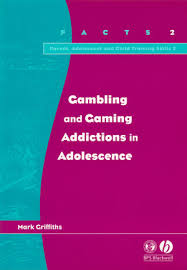
Griffiths, M.D. (2002b). Gambling and Gaming Addictions in Adolescence. Leicester: British Psychological Society/Blackwells.
Griffiths, M.D. (2003). The therapeutic use of videogames in childhood and adolescence. Clinical Child Psychology and Psychiatry, 8, 547-554.
Griffiths, M.D. (2004a). Odds and sods: You (nearly) win again. The Guardian, April 20, p. 6.
Griffiths, M.D. (2004b). Can videogames be good for your health? Journal of Health Psychology, 9, 339-344.
Griffiths, M.D. (2005). Self-citation: A practical guide. Null Hypothesis: The Journal of Unlikely Science (‘Best of’ issue), 15-16.
Griffiths, M.D. (2008). The biopsychosocial and “complex” systems approach as a unified framework for addiction. Behavioral and Brain Sciences, 31, 446-447.
Griffiths, M.D. (2010). The role of context in online gaming excess and addiction: Some case study evidence. International Journal of Mental Health and Addiction, 8, 119-125.
Griffiths, M. (2013). The art of self-citation. Article submitted for publication.
Griffiths, M.D. (2014). Sunshine: As addictive as heroin? Washington Post. June 24. Located at http://www.washingtonpost.com/posteverything/wp/2014/06/24/sunshine-as-addictive-as-heroin/
Griffiths, M. (2016a). Personal communication with myself. September 29, 2016.
Griffiths, M.D. (2016b). Personal communication with myself. September 29, 2016.
Griffiths, M.D. (2016c). It will rule your life but addicts can be helped. Sunday Mirror, May 1, p.5.
Griffiths, M.D. (2016d). Sorry may be the hardest word but more people than ever are saying it. Nottingham Post, April 11, p.14.
Griffiths, M.D. (2016e). Market forces: Does gambling advertising increase problem gambling? August 22. Located at: https://drmarkgriffiths.wordpress.com/2016/08/22/market-forces-does-gambling-advertising-increase-problem-gambling/
Griffiths, M.D., Kuss, D.J., Billieux J. & Pontes, H.M. (2016). The evolution of internet addiction: A global perspective. Addictive Behaviors, 53, 193–195.
Kuss, D.J., Griffiths, M.D. & Binder, J. (2013). Internet addiction in students: Prevalence and risk factors. Computers in Human Behavior, 29, 959-966.
Mithgriffs, G. (2015). Whose self-citation is it anyway? Occasional Made-Up Paper (No.3).
Net bets: What makes betting online attractive to gamblers?
Over the past two decades I have carried out a lot of research on what factors are important in attracting people to engaging in online activities such as online video gaming, online gambling, online shopping, and online sex. Research has shown that virtual environments have the potential to provide short-term comfort, excitement and/or distraction – all of which can be highly reinforcing to internet users. My research has consistently shown that there are many generic factors that facilitate online use including accessibility, anonymity, affordability, convenience, escape, immersion, interactivity, disinhibition, and simulation. Today’s blog briefly examines these factors.


Accessibility – Access to the Internet is now commonplace and widespread, and can be done easily from the home, the workplace and (via mobile gambling) on the move. Given that the uptake of consumptive behaviours is strongly correlated with increased access to the activity, it is not surprising that the incidence of activities like online gambling and online gaming is slowly increasing across different populations across the world. Fundamentally, increased accessibility of these activities enables the individual to rationalize involvement by removing previously restrictive barriers such as time constraints emanating from occupational and social commitments.
Anonymity – The anonymity of the Internet allows users to privately engage in such activities as sex and gambling without the fear of stigma. This anonymity can also provide the user with a greater sense of perceived control over the content, tone, and nature of the online experience. Anonymity also has the capacity to increase feelings of comfort since there is a decreased ability to look for, and thus detect, signs of insincerity, disapproval, or judgment in facial expression, as would be typical in face-to-face interactions. For activities such as gambling, this may be a positive benefit – particularly when losing – as no-one will actually see the face of the loser. Anonymity, like increased accessibility, may reduce social barriers to engaging in gambling, particularly skill-based gambling activities such as poker that are relatively complex and often possess tacit social etiquette. The potential discomfort of committing a structural or social faux-pas in the gambling environment because of inexperience is minimized because the individual’s identity remains concealed.
Affordability – Given the wide accessibility of the Internet, it is now relatively inexpensive to use online services on offer. Furthermore, the overall cost of has been reduced significantly through technological developments, again, rendering affordability less of a restrictive force when it comes to rationalizing involvement in the behaviour. For example, the saturation of online gambling industry has lead to increased competition, and the consumer is benefiting from the ensuing promotional offers and discounts available on gambling outlay. Regarding interactive wagering, the emergence of peer-to-peer gambling through the introduction of betting exchanges has provided punters with commission free sporting gambling odds, which in effect means the player needs to risk less money to obtain potential revenue. Finally, ancillary costs of face-to-face gambling, such as parking, tipping and purchasing refreshments, is removed when gambling within the home and therefore the overall cost of gambling is reduced making it more affordable.
Convenience – Online behaviours usually occur in the familiar and comfortable environment of home or workplace thus reducing the feeling of risk and allowing even more adventurous behaviours. For the internet user, not having to move from their home or their workplace is of great positive benefit and increases the attractiveness of online activities compared to offline activities.
Escape – For some internet users, the primary reinforcement to engage in an online behaviour is the gratification they experience online. However, the experience of activities like online gambling, online gaming and/or online sex may be reinforced through a subjectively and/or objectively experienced ‘high’ or positive change in mood state. The mood-modifying experience has the potential to provide an emotional or mental escape and further serves to reinforce the behaviour. In short, online activities can provide a potent escape from the stresses and strains of real life.
Immersion – The medium of the Internet can provide feelings of dissociation and immersion and may facilitate feelings of escape (see above). Immersion can produce lots of different types of feelings that may be reinforcing for the internet user such as losing track of time, feeling like you’re someone else, and being in a trance like state.
Interactivity – The interactivity component of the Internet can also be psychologically rewarding and different from other more passive forms of entertainment (e.g., television). The interactive nature of the Internet can therefore provide a convenient way of increasing such personal involvement that can – in online situations – lead to increased online use. Furthermore, the alternative methods of peer interaction are available within interactive online activities that retain the socially reinforcing aspects of the behaviour. Individuals can communicate via computer-mediated communication in most online activities (including gambling and gaming).
Disinhibition – The feeling of disinhibition is one of the Internet’s key appeals as there is little doubt that the Internet makes people less inhibited when they are online. Online users appear to open up more quickly online compared to offline situations and reveal themselves emotionally much faster than in the offline world. This has been referred to by Dr. John Suler as ‘hyperpersonal communication’. According to Dr. Suler, this occurs because of four features of online communication:
- The communicators usually share social categories so will perceive each other as similar (e.g., all online poker players)
- The message sender can present themselves in a positive light, and so may be more confident
- The format of online interaction (e.g., there are no other distractions, users can spend time composing messages, mix social and task messages, users don’t waste cognitive resources by answering immediately)
- The communication medium provides a feedback loop whereby initial impressions are built upon and strengthened.
Simulation – Finally, simulations provide an ideal way in which to learn about something and which tends not to have any of the possible negative consequences. For instance, most online gambling sites have a practice mode format, where potential gamblers can place a non-monetary bet in order to see and practice the procedure of gambling on that site. Furthermore, gambling in practice modes can build self-efficacy and potentially increase perceptions of control in determining gambling outcomes motivating participation in their ‘real cash’ counterparts within the site.
Dr Mark Griffiths, Professor of Gambling Studies, International Gaming Research Unit, Nottingham Trent University, Nottingham, UK
Further reading
Griffiths, M.D. (1998). Internet addiction: Does it really exist? In J. Gackenbach (Ed.), Psychology and the Internet: Intrapersonal, Interpersonal and Transpersonal Applications. pp. 61-75. New York: Academic Press.
Griffiths, M.D. (2003). Internet gambling: Issues, concerns and recommendations. CyberPsychology and Behavior, 6, 557-568.
Griffiths, M.D. (2009). Internet gambling in the workplace. Journal of Workplace Learning, 21, 658-670.
Griffiths, M.D. (2010). Gambling addiction on the Internet. In K. Young & C. Nabuco de Abreu (Eds.), Internet Addiction: A Handbook for Evaluation and Treatment (pp. 91-111). New York: Wiley.
Griffiths, M.D. (2010). Internet abuse and internet addiction in the workplace. Journal of Worplace Learning, 7, 463-472.
Griffiths, M.D. (2012). Internet sex addiction: A review of empirical research. Addiction Research and Theory, 20, 111-124.
Griffiths, M.D., Kuss, D.J., Billieux J. & Pontes, H.M. (2016). The evolution of internet addiction: A global perspective. Addictive Behaviors, 53, 193–195.
Griffiths, M.D. & Parke, J. (2002). The social impact of internet gambling. Social Science Computer Review, 20, 312-320.
Griffiths M.D. & Szabo, A. (2014). Is excessive online usage a function of medium or activity? An empirical pilot study. Journal of Behavioral Addictions, 3, 74–77.
Kuss, D.J. & Griffiths, M.D. (2011). Online social networking and addiction: A literature review of empirical research. International Journal of Environmental and Public Health, 8, 3528-3552.
Kuss, D. & Griffiths, M.D. (2012). Internet gambling behavior. In Z. Yan (Ed.), Encyclopedia of Cyber Behavior (pp.735-753. Pennsylvania: IGI Global
Kuss, D.J. & Griffiths, M.D. (2012). Online gaming addiction in adolescence: A literature review of empirical research. Journal of Behavioral Addictions, 1, 3-22.
Kuss, D.J. & Griffiths, M.D. (2012). Internet and gaming addiction: A systematic literature review of neuroimaging studies. Brain Sciences, 2, 347-374.
Kuss, D.J. & Griffiths, M.D. (2012). Online gaming addiction: A systematic review. International Journal of Mental Health and Addiction, 10, 278-296.
Kuss, D.J., Griffiths, M.D., Karila, L. & Billieux, J. (2014). Internet addiction: A systematic review of epidemiological research for the last decade. Current Pharmaceutical Design, 20, 4026-4052.
Pontes, H.M., Kuss, D.J. & Griffiths, M.D. (2015). The clinical psychology of Internet addiction: A review of its conceptualization, prevalence, neuronal processes, and implications for treatment. Neuroscience and Neuroeconomics, 4, 11-23.
Pontes, H.M., Szabo, A. & Griffiths, M.D. (2015). The impact of Internet-based specific activities on the perceptions of Internet Addiction, Quality of Life, and excessive usage: A cross-sectional study. Addictive Behaviors Reports, 1, 19-25.
Suler, J. (2004). The online disinhibition effect. CyberPsychology & Behavior, 7, 321-326.
Widyanto, L. & Griffiths, M.D. (2006). Internet addiction: A critical review. International Journal of Mental Health and Addiction, 4, 31-51.
Widyanto, L. & Griffiths, M.D. (2009). Unravelling the Web: Adolescents and Internet Addiction. In R. Zheng, J. Burrow-Sanchez & C. Drew (Eds.), Adolescent Online Social Communication and Behavior: Relationship Formation on the Internet. pp. 29-49. Hershey, Pennsylvania: Idea Publishing.
Dying for it: Bizarre autoerotic deaths (Part 2)
In my previous blog I examined some of the most bizarre autoerotic deaths reported in the medical forensic literature. Here are another five.
Case 1: Autoerotic death by aerosol propellant
Source: Medicine, Science and the Law. Personal details: 32-year old white US man. Single. Computer programmer.
- Bizarre death event: Found dead in bed with cassette recorder next to him. He was wearing headphones which playing “snorting” horse sounds. There was also a can of aerosol propellant. At the end of the bed was a large painting of a male strapped to the hind legs of a horse who was being anally penetrating by the horse. The horse was ridden by a leather-clad woman. He was also wearing some kind if homemade masturbatory device. His death was recorded as cardio-respiratory failure consistent with aerosol propellant abuse (death by misadventure). Self-administration of the chemical agent to modify the sensations of masturbation. He was covered in dry semen stains.
Case 2: Autoerotic death by clothing
Source: Medicine, Science and the Law. Personal details: 25-year old Japanese male. Single.
- Bizarre death event: Man found dead in his bed one morning. naked except for clothing wrapping his head and underpants which were pulled down. He was covered in dry semen stains. He had put a black skirt on his face and then pulled a second skirt upside down over his head and turned down the bottom of it. He then put a plastic bag over these two garments followed by a pair of tights. The legs of the tights were used to tie a knot around the bottom of the skirts. He then wrapped a third skirt around all of this. Death was due to suffocation.
Case 3: Autoerotic death by hanging (female)
Source: Handbook of Forensic Pathology. Personal details: 19-year old white female. Single. College student.
- Bizarre death event: Woman was found dead in her bedroom hanging from the hinge of her closet door dressed as an Oriental “harem girl”. A window sash cord was tied around her body in a complicated fashion and she was also wearing a blindfold and mouth gag (made from the belt of her dressing gown). Next to her lay an underground magazine (this was folded out and showed a bizarre dance involving a clock – the minute hand being a nude male who would make love with the other figure on the hour), a paperback Hitchcock book which explained her fantasy. The paperback contained the story about an Oriental harem master. In this story the harem master provides girls to his lord who stored them by hanging them around his walls on hooks

Case 4: Autoerotic death by vacuum cleaner
Source: American Journal of Forensic Medicine and Pathology. Personal details: 57-year old white US male. Single. History of heart disease and chronic pancreatitis
- Bizarre death event: Man was found naked slumped over his vacuum cleaner after a neighbour wondered why the vacuum cleaner had been on continuously for a long time. The man was found leaning against the dining table with his testicles, buttocks and thighs tightly bound with women’s tights. Near the table was a jar of urine, jars of lubricant and a wooden table leg covered in fecal excrement. The man was covered in burns from the vacuum cleaner. No defect was found in the vacuum cleaner. The man basically had a heart attack while engaged in autoerotic activity. The wooden table leg had been used in an attempt to stimulate orgasm via anal penetration. His wife had caught him masturbating with the vacuum cleaner before (they hadn’t had sex for five years). The death was classed as natural rather than accidental.
Case 5: Autoerotic death by hydraulic tractor shovel
Source: Journal of Forensic Sciences. Personal details: 62 year-old US white male. Married. Farmer.
- Bizarre death event: Found dead in a barn lying on his front pinned under the hydraulic shovel of his tractor. His body was covered with semen stains and there was evidence of masochistic sexual bondage. His clothes were folded neatly away nearby. He was found naked except for a pair of women’s red shoes (with 8 inch heels), knee high stockings and tape duct wrapped around his ankles. Ropes led from his feet to the tractor which when raised would lift his inverted body causing complete suspension. It is not known exactly what happened but it is likely that the engine stalled and he was crushed underneath the tractor shovel. He died of positional asphyxiation by chest compression. This was an atypical autoerotic fatality because he did not purposely use asphyxiation but it did cause his death.
Dr. Mark Griffiths, Professor of Behavioural Addiction, International Gaming Research Unit, Nottingham Trent University, Nottingham, UK
Further reading
Aggrawal A. (2009). Forensic and Medico-legal Aspects of Sexual Crimes and Unusual Sexual Practices. Boca Raton: CRC Press.
Byard, R. W. (1994). Autoerotic death—characteristic features and diagnostic difficulties. Journal of Clinical Forensic Medicine, 1(2), 71-78
Cordner, S.M. (1983). An unusual case of sudden death associated with masturbation. Medicine, Science and the Law, 23(1), 54-56
Dietz, P. E., & O’Halloran, R.L. (1993). Autoerotic fatalities with power hydraulics. Journal of Forensic Science, 38(2), 359-364.
Ikeda, N., Harada, A., Umetsu, K., & Suzuki, T. (1988). A case of fatal suffocation during an unusual auto-erotic practice. Medicine, Science and the Law, 28(2), 131-134.
Imami, R. H., & Kemal, M. (1988). Vacuum cleaner use in autoerotic death. American Journal of Forensic Medicine and Pathology, 9(3), 246-248.
Love, B. (2001). Encyclopedia of Unusual Sex Practices. London: Greenwich Editions.
Sauvageau, A., & Racette, S. (2006). Autoerotic deaths in the literature from 1954 to 2004: A review. Journal of Forensic Sciences, 51(1), 140-146.
Dying for it: Bizarre autoerotic deaths (Part 1)
In previous blogs I have examined many different sexual paraphilias that have ended up in death for individuals engaged in such practices. Many of these are from autoerotic asphyxiation but also from other sexual practices such as electrophilia and anaesthesiophilia. Today’s blog takes a brief look at some of the most bizarre autoerotic deaths reported in the medical forensic literature.
Case 1: Autoerotic death by car
Source: Journal of Forensic Sciences. Personal details: 40-year old white US male airline pilot. Married and father of two children.
- Bizarre death event: A man left his home at 6am in the morning and told his wife that he was going shooting in the country. He was found naked except for a large-link 10-foot chain harness secured around his body. (The harness was tied around the man’s neck in a moderately tight loop and bolted. The chain then went down his chest and was tied into another loop around his waist. This was tied to the bumper of the car) at 7.30am in the morning in a remote area crushed against the left fender of his car (equivalent of a VW beetle). The engine was still running, ignition was on and the driver’s door was still open. The steering wheel was tied so that it would go round in anti-clockwise circles. His clothes were in the boot of the car. Reconstruction of the events leading to his death showed that he was either being dragged round by the car or following the car producing feelings of asphyxia. When he had finished his sexual turn-on he had tried to approach the car door but had forgotten to undo the chain from the bumper. The chain had got tangled up in the car’s axle and the man was found strangled to death by the chain.
Case 2: Autoerotic death by hanging (male)
Source: American Journal of Forensic Medicine and Pathology. Personal details: 57-year old white US male. Single.
- Bizarre death event: Early one winter’s morning, two joggers found a partially clothed man hanging from a tree five inches from the ground. He was hanging from a rope tied round his neck but also had two other loops of rope harness around his thighs which also encircled his chest. His neatly folded clothes lay two feet away along with lipstick and a jar of Vaseline. He was wearing a woman’s brown wig and a stuffed white bra. He also wore a pair of men’s red underpants, a pair of tights and a pair of high-heeled women’s shoes. He was also found to have a carrot protruding from his anus. Basically his seat harness slipped and he asphyxiated himself on the ropes.
Case 3: Autoerotic death by blankets
Source: American Journal of Forensic Medicine and Pathology. Personal details: 60-year old white US male. Single. Diagnosed schizophrenic and had various sexual compulsions. Well educated former teacher.
- Bizarre death event: After being reported missing from work by his employer, a man was found dead rolled up in 14 different blankets which had been sewn together (the two outermost layers were found fixed with adhesive tape in various places which raised the possibility of murder). Inside the blankets he was dressed in two pairs of hotpants, a pair of long johns and a vest. The body was wet and his hands and arms were outstretched above his head. They found a plastic bag over his penis into which he had ejaculated. He was masturbating while inside the blankets but he had become too hypoxic and died. He was immobilized inside the blankets and was unable to free himself. Over the last few years he had bought an astonishing number of blankets by mail order (over 60 found in his apartment most of which seemed to have some ritual or obsessive meaning by the way were laid out. No pornography was found in the place.
Case 4: Autoerotic death by dental anaesthetic
Source: American Journal of Forensic Medicine and Pathology. Personal details: 59-year old white US male. Single. Antiques dealer
- Bizarre death event: Found dead in his locked apartment. He was seated in front of a dental anaesthetic machine with the anaesthetic face-mask over his face. He was sucking on a rubber teat similar (but much bigger) than a baby’s feeding bottle. There were other anaesthetic machines around the apartment as well as a lot of sexual literature (magazines, photographs, paintings, manuscripts all concerned with his elaborate fetish some of which included photographs of himself in these situations). He was wearing a rubber type apron, three woollen cardigans, a woman’s blouse and two pairs of women’s trousers and a pair of women’s bloomers.
Case 5: Autoerotic death by electrocution
Source: Medicine, Science and the Law. Personal details: 36-year old UK male. Gay (with partner). Unemployed ex-television engineer
- Bizarre death event: Man found dead with a wire cradle applied to his scrotum with another loop of wire (end folded over) inserted into his Vaseline-lubricated anus. The wires were connected to the two terminals that supplied the loudspeaker within the television. When switched on, these wires carried a current of 0.6 amps at 2.2 volts (a quarter of the current needed to light a small torch). The body had two significant injuries. One on the right side of his face (entrance mark of the current), and the other over the left side of his scrotum (where the loop of the wire had been). Unfortunately, one of the wires had broken off resulting in a cessation of the stimulating activity. The man looked inside the back of the open TV set and his face came into contact with an exposed metal cap which zapped 2500 volts through him. The metal cap was the only live part of the television set and it was this that killed him.
(Part 2 can be found here).
Dr. Mark Griffiths, Professor of Behavioural Addiction, International Gaming Research Unit, Nottingham Trent University, Nottingham, UK
Further reading
Aggrawal A. (2009). Forensic and Medico-legal Aspects of Sexual Crimes and Unusual Sexual Practices. Boca Raton: CRC Press.
Eriksson, A., Gezelius, C., & Bring, G. (1987). Rolled up to death: An unusual autoerotic fatality. American Journal of Forensic Medicine and Pathology, 8(3), 263-265.
Hazelwood, R. R., Burgess, A. W., & Groth, A. N. (1981). Death during dangerous autoerotic practice. Social Science & Medicine. Part E: Medical Psychology, 15(2), 129-133.
Hiss, J., Rosenberg, S. B., & Adelson, L. (1985). ” Swinging in the park”: An investigation of an autoerotic death. American Journal of Forensic Medicine and Pathology, 6(3), 250-255.
Klintschar, M., Grabuschnigg, P., & Beham, A. (1998). Death from electrocution during autoerotic practice: case report and review of the literature. American Journal of Forensic Medicine and Pathology, 19(2), 190-193.
Leadbeatter, S. (1988). Dental anesthetic death: An unusual autoerotic episode. American Journal of Forensic Medicine and Pathology, 9(1), 60-63.
Love, B. (2001). Encyclopedia of Unusual Sex Practices. London: Greenwich Editions.
Minyard, F. (1985). Wrapped to death. Unusual autoerotic death. The American Journal of Forensic Medicine and Pathology, 6(2), 151-152
Rupp, J. C. (1973). The love bug. Journal of Forensic Science, 18(3), 259-262.
Sauvageau, A., & Racette, S. (2006). Autoerotic deaths in the literature from 1954 to 2004: A review. Journal of Forensic Sciences, 51(1), 140-146.
Confession session: The psychology of apology
(Please note: The following blog is an extended version of an article that was first published earlier this year in the Nottingham Post).
Back in March 2016, Nottingham Labour Councillor Alan Rhodes made a public apology after the former social worker Andris Logins was jailed for 20 years for rape and abuse of children at a Nottinghamshire care home. Mr Rhodes said: “It was our role to keep children safe and we clearly didn’t” and that “we failed in our duty of care”. Although most of us apologise for all sorts of things each day, it’s becoming increasingly common for a ‘non-celebrities’ to say sorry in a public way – particularly for historical events that the person giving the apology had no part in.
There are three main ways of saying sorry. The first is the apology with no excuse, when we don’t try to justify what we’ve done. We simply take full responsibility and promise it will never happen again. Secondly, there’s the excuse apology when we say we’re sorry but also add it wasn’t our fault. For instance, we might blame someone else, an accident, human error, or a lapse of judgement. With the third type of apology, we don’t feel we’ve done wrong, but offer some sort of justification. If we’ve wronged someone, we might say they deserved it. We might even feel what we’ve done is so trivial it’s not even worth bothering about. Dr. Aaron Lazare, author of the 2005 book On Apology, says that an apology is one of the most profound interactions that two human beings can have between one another
But why do we apologise? Psychologist Dr. Guy Winch views apologies as linguistic tools that help us acknowledge violations of social expectations and norms. He also says that apologies help us take direct responsibility for the impact of our actions on other individuals and provide a way of asking for forgiveness. Consequently, we are able to repair our relationships with those individuals, restore our own social standing, and help ease guilt and/or shame. Confessing and saying sorry is a simple way to get rid of all those negative feelings. The guilt created by transgressions, such as lying on a CV, or cheating in an exam, can eat away at some people for years.
There also appear to be gender differences. Research studies have tended to find that women appear to say sorry far more than men, because men feel they’re ‘one down’ to someone if they offer an apology. In contrast, women will say sorry for things they haven’t done because they prefer to smooth things over quickly and keep relationships going. However, the differences may be more nuanced. One study found no differences between men and women in the number of the proportion of offenses that prompted apologies but men apologized less frequently than women because they had a higher threshold for what constitutes offensive behaviour. Another study found that men apologized more frequently to women than they did to other men.
We also appear to have developed a ‘confessional culture’ over recent years in which celebrities and politicians are keener than ever to publicly admit to their private indiscretions. It could be that we’re more forgiving of public figures and that because we know more about the pressures of fame, we empathise with them. Another reason might be we no longer care because we don’t think what someone does in the private life affects their job. One thing we do expect from public figures is for their apologies to be sincere.
Arguably one of the most high profile examples was former US president Bill Clinton and his sexual relationship with Monica Lewinsky. Although Clinton continually denied for seven months any such relationship, when he eventually said sorry in August 1998, it was seen as sincere and many people sympathised with him. By apologising sincerely, or appearing to, public figures demonstrate they’re human, with weaknesses just like the rest of us.

These days, celebrities are quick to admit to what they’ve done. Lots of actors, comedians, singers and sports people have confessed to their addictions to drugs, alcohol and gambling before checking into high profile clinics like The Priory. For some, it’s no doubt a cynical move to help their public image. By apologising promptly, they’re seen as being brave, and any bad publicity will die down more quickly. Those who offer belated, grudging apologies see their image suffer.
Apologies can also help those who receive them. Police forces up and down the country have piloted schemes where criminals are confronted by their victims and offered a chance to apologies (known as ‘restorative justice’). Many victims say the one thing they’d really appreciate is an apology, and they’re often grateful to receive on. As the saying goes, “sorry seems to be the hardest word” but it has the potential to mean so much to so many.
Dr. Mark Griffiths, Professor of Behavioural Addiction, International Gaming Research Unit, Nottingham Trent University, Nottingham, UK
Further reading
Bachman, G. F., & Guerrero, L. K. (2006). Forgiveness, apology, and communicative responses to hurtful events. Communication Reports, 19(1), 45-56.
Griffiths, M.D. (2000). Saying sorry can make you feel so much better. The Sunday Post, January 23, p. 30-31.
Griffiths, M.D. (2016). Sorry may be the hardest word but more people than ever are saying it. Nottingham Post, April 11, p.14.
Fehr, R., & Gelfand, M.J. (2010). When apologies work: How matching apology components to victims’ self-construals facilitates forgiveness. Organizational Behavior and Human Decision Processes, 113(1), 37-50.
Frantz, C.M., & Bennigson, C. (2005). Better late than early: The influence of timing on apology effectiveness. Journal of Experimental Social Psychology, 41(2), 201-207.
Lazare, A. (2005). On Apology. Oxford: Oxford University Press.
Scher, S. J., & Darley, J. M. (1997). How effective are the things people say to apologize? Effects of the realization of the apology speech act. Journal of Psycholinguistic Research, 26(1), 127-140.
Struthers, C. W., Eaton, J., Santelli, A. G., Uchiyama, M., & Shirvani, N. (2008). The effects of attributions of intent and apology on forgiveness: When saying sorry may not help the story. Journal of Experimental Social Psychology, 44(4), 983-992.
Takaku, S. (2001). The effects of apology and perspective taking on interpersonal forgiveness: A dissonance-attribution model of interpersonal forgiveness. Journal of Social Psychology, 141(4), 494-508.
Takaku, S., Weiner, B., & Ohbuchi, K.I. (2001). A cross-cultural examination of the effects of apology and perspective taking on forgiveness. Journal of Language and Social Psychology, 20(1-2), 144-166.
Winch, G. (2013). Emotional First Aid: Healing Rejection, Guilt, Failure, and Other Everyday Hurts. London: Penguin.
Working while lurking: A brief look at participant observation in online forums
In offline situations, many social science researchers have employed ethnographic methods as a means of understanding and describing different culture and behaviours. However, ethnographic methods can also be used online for studying various types of excessive behaviour. For instance, I argued in a 2010 paper in the International Journal of Mental Health and Addiction that by being online, gaming researchers have the capacity to become a part of the phenomenon that is being studied. Recently, I along with a number of my research colleagues at Nottingham Trent University, published a paper in Studia Psychologia that online forums are providing a new and innovative methodology for data collection in the social sciences.

For those who don’t know, ethnography focuses on accounting for the actions and intentions of the studied social agents, and outlining how such behaviour is rationalized and understood by the wider group. Traditionally derived from anthropology, ethnography aims at studying people and their behaviours and cultures within their socio-cultural contexts. Behaviours and communications are engulfed with meaning by being situated within the field site. What is needed on behalf of the researcher is what Dr. Clifford Geertz described as the production of a “thick description” of what takes place in these field sites to discern the latter’s contextualized meaning.
When it comes to virtual (i.e., online) ethnography, it is important to notice that while in-person ethnography is constrained by the laws of the physical world where the researcher needs to interact with the participants, online ethnography or as Dr. Robert Kozinets calls it in his 2010 book about online ethnography – “netnography” – can be done in a more unobtrusive way without the need to interact with the participants. Lurking is a possibility that Dr. Kozinets describes as opening a “window into naturally occurring behaviour” without the interference of the researcher.
Virtual ethnography takes the idea of participant observation a step further by challenging the notion of a geographically bound and relatively stagnant field site by replacing it with the virtual sphere that has no set boundaries. In this respect, virtual ethnography is what Dr. Christine Hine says “ethnography in, of and through the virtual”. The Internet is used as place, topic and means of research. It is an important qualitative online methodology and has been used in a variety of different research endeavours, including the studies of people’s explorations of multi-layered identities on the Internet, different levels of online experience, and playing Massively Multiplayer Online Role-Playing Games such as Everquest.
There are a number of principles that underlie virtual ethnography. Ethnographers must immerse themselves in the (virtual) field site in order to gain an in depth insight into why and how interactions take place and what they mean within the context of the respective virtual sphere. However, the relationship of the latter’s agents to their real (embodied) lives cannot be disregarded. The online space is a space ‘in between’ that is connected to the world outside of the Internet. Therefore, virtual ethnography is but a partial study and cannot deliver a full account of what it sets out to study. It can never be a holistic approach. Nevertheless, this is aided by the researchers who must be reflexive about what they experience, and about the method they use. The involvement of the researcher and the researcher’s interpretation of the actions and communications that occur within the virtual field site are integral to this type of research. In addition to this, the technology of the Internet itself is essential because it provides the tools for, the objects and the context of analysis.
Given the wide variety of advantages of and important insights virtual ethnography can offer for the researcher, potential disadvantages also need to be taken into consideration. The researchers’ active participation in the field site offers them the possibility of in-depth insights that would not be possible without their involvement. However, at the same time, they might lose their critical distance towards the object of their study. Sacrificing some critical distance therefore is a trade-off for in the collection of invaluable and profound data. As Dr. Christine Hine notes, these data are necessarily biased by the researchers’ experience and perception of online interactions in the respective realm that, due to their immersion, is knowledgeable and familiar.
Dr. Adrian Parke and I applied online ethnography to the study of poker skill development within online poker forums, and published our findings in a 2011 issue of the International Journal of Cyber Behavior, Psychology and Learning. Our study was a virtual ethnographical research design looking at how poker gamblers utilized computer-mediated communication (CMC) to develop their poker skill and profitability, and to examine the factors associated with problem gambling. The study was a six-month participant observational analysis of two independent online poker forums. Dr. Parke participated in poker gambling during the entire study period and used strategies proposed from forum members to develop poker ability. This approach provided an insider’s perspective into how skill development through CMC affects poker gambling behaviour.
We generated forum discussions regarding specific behavioural concepts and cognitive processes based on accumulative analysis of emergent data from the online poker players. Forum interaction was observed, monitored and analyzed through traditional content analytic methods. Membership and participation in such online community forums provided poker players the opportunity to benefit from the consequences of reporting gambling experience and acquiring both poker gambling structural knowledge and skill.
One of the key advantages of data collection via online forums is that it can provide a detailed record of events that can be revisited after the event itself has finished. Furthermore, screen captures can be taken and used as examples or related back to the data collected – something that has been used in the gaming studies field (and outlined in a 2007 paper I published with Dr. Richard Wood in the International Journal of Mental Health and Addiction). Study findings can be posted on bulletin boards and participants have the opportunity to comment on their accuracy or comment on any other observations that they may have. This also helps to empower the participant and can prevent misrepresentation.
Given the increase in the number of hours we now spend online every day, carrying out research online is going to become an ever more popular (and useful).
Dr Mark Griffiths, Professor of Gambling Studies, International Gaming Research Unit, Nottingham Trent University, Nottingham, UK
Further reading
Geertz, C. (1973). The interpretation of cultures: Selected essays. London: Fontana Press.
Griffiths, M.D. (2010). The use of online methodologies in data collection for gambling and gaming addictions. International Journal of Mental Health and Addiction, 8, 8-20.
Griffiths, M.D., Lewis, A., Ortiz de Gortari, A.B. & Kuss, D.J. (2016). Online forums and blogs: A new and innovative methodology for data collection. Studia Psychologica, in press.
Hine, C. (Ed.). (2005). Virtual methods. Issues in social research on the Internet. Oxford, UK: Berg.
Hine, C. (2000). Virtual ethnography. London: Sage.
Kozinets, R.V. (2010). Netnography. Doing ethnographic Research Online. Sage: London.
Parke, A., & Griffiths, M.D. (2011). Poker gambling virtual communities: The use of Computer-Mediated Communication to develop cognitive poker gambling skills. International Journal of Cyber Behavior, Psychology and Learning, 1(2), 31-44.
Wood, R.T.A. & Griffiths, M.D. (2007). Online data collection from gamblers: Methodological issues. International Journal of Mental Health and Addiction, 5, 151-163.
Wood, R.T.A., Griffiths, M.D. & Eatough, V. (2004). Online data collection from videogame players: Methodological issues. CyberPsychology and Behavior, 7, 511-518.
Ova and out there: A brief look at ‘alien egg’ fetishes
When I originally started researching material for this blog, it was going to be about ‘insertion fantasy fetishes’ which refer to the sexual desires or fantasies of having something inserted into a person via any means in the pelvic region (vaginally, anally), with the insertion object typically being something out of the ordinary such as specifically shaped foods, abnormal objects, or even whole people (and which borders with sexual parahilias such as macrophilia and microphilia that I examined in previous blogs). However, when I typed in the words to Google, one article jumped out at me, an article in the online magazine Vice entitled ‘The emerging fetish of laying alien eggs inside yourself’ by Toby McCasker.
I am no stranger to the literature on alien fetishes and in a previous blog I reviewed the scant literature on exophilia (individuals who derive sexual pleasure and arousal from extraterrestrial, robotic, supernatural, or otherwise non-human life forms). The overwhelming majority of exophiles never claim to have had sex with an alien but claim that they are sexually excited and aroused by the thought of doing so. However, the topic of this blog does not fall under exophilia but does comprise an activity that could said to be part of an ‘insertion fetish’.
After reading the rest of this blog you may come to the conclusion that it is a thinly disguised advert for Primal Hardwere (PH) but I can assure you that it isn’t. It just happens that the focus of this article (sexual arousal from the insertion of ‘alien eggs’ into the vagina or anus) uses a product that is only available (as far as I am aware) from PH. McCasker’s article started like a number of my own:
“Recently, while on the internet looking at weird sex things, I came upon the gushing testimony of a young woman who had just discovered Primal Hardwere’s patented Ovipositor; one of the most unusual and confronting sex toys I’ve ever heard of. The Ovipositor is basically a big dildo that lays goopy eggs molded from gelatin in the body cavity of your choice. Fans of the Ovipositor say that the sensation of mushy extraterrestrial ovum slopping back out of them is a real treat. The owner of Primal Hardwere is a man who insisted I refer to him only as LoneWolf. A Native American of indeterminate age, he apparently worked as a builder, fast food dude, fashion model, church organist, butcher, and pursued veterinary medicine at the University of New Hampshire”.


For those who are unaware, an ovipositor is an organ used by some animals for the laying of eggs and the most infamous ovipositor I can think of is the one belonging to the alien queen xenomorph in the film Alien: Resurrection. (In fact, the original title of this article was going to be ‘Ripley’s believe it or not’ given that the heroine of all the Alien films is Ellen Ripley, but I decided that too few people would appreciate the pun). McCasker asked the developer of the Ovipostor dildo to explain the product and the thinking behind it:
“The idea is to replicate the act of being impregnated with eggs. Usually from an alien or insect. If you’ve seen the Aliens movies, you’ll get the picture. Many people find this sort of thing very arousing. The toys are simply phallic-shaped hollow tubes that can be used to insert gelatin eggs into oneself. There is a funnel-shaped hole in the bottom to receive the eggs, which are inserted one by one, forcing them up the tube and out the top…Let’s face it, there are three things that will always sell: Food, death, and sex. I tried food service and decided after managing three restaurants and owning one that it was the same thing, day in and day out, and it didn’t look like that was going to change much. Death didn’t really interest me. I wanted something more fun. Something that breaks the monotony of people’s days and makes them spit out their coffee when you tell them what you do…I wanted to push the boundaries of people’s comfort levels, make them question their own erections and wet panties, and let them know their fantasies do not have to go unrealized”.
Obviously PH didn’t start making the ovipositor dildos on a whim but it all began after ‘LoneWolf’ had created some one-off customized commissions prior to setting up PH. Unsurprisingly, no other company was (and is) making such products and ‘LoneWolf’ saw a gap in the market (or created a new market depending upon your perspective). As he told McCasker:
“Ovipositors were requested several times, and when I posted YouTube videos demonstrating them, the response was impressive. Tons of people wanted them – and while this is not a fetish of my own, I saw potential for a unique product line…[In terms of who buys the ovipositor dildos] the real answer here is simply ‘people’. I truly can’t say that it’s strictly one group or mindset or any other kind of convenient stereotype that like these sorts of things. People get turned on by many things beyond what our respective societies would deem ‘normal’ We are niche in the sense that we’re catering to some of the lesser catered-to fetishes. We send our products all over the world to many different races, creeds, and cultures…[In terms of appeal] there are different perspectives of everything, and Ovipositors are no exception. Many like to envision an alien creature that wants its eggs inside you. It can be a little intimidating or off-putting to those who do not fantasize about being the willing or unwilling host of alien beings inside them. It blurs the line of our own humanity to find sexual pleasure with something that is so far from human, and for some, just talking about it gets them wet”.
McCasker also wanted to know if there is any danger of inserting gelatin eggs into the vagina and anus and replied:
“Everything in moderation. We are not doctors, and we’re not about to comment on what is safe or unsafe to do to one’s body as it varies from person to person. I can say that I have used them many times without hurting myself, but frankly it is up to the person using it to know their own limits. For instance, if you are allergic to gelatin. If made properly, the eggs are firm, but rubbery, similar to the consistency of gummy bears. They dissolve with body heat rather quickly”.


I’m sure that such an explanation would not encourage many individuals to try out such a sex toy (and you may want to read my previous blog on rectal foreign bodies before making any such decision). Following the publication of McCasker’s article, dozens of other online news outlets picked up on the story (such as that in Uproxx, Nuvo, Philly Mag and Bust) and in some cases made the national UK tabloid news (such as a story in the Daily Star). What is not made clear is that individuals wanting to use the Ovipostor have to make the gelatin eggs themselves (but at least there’s a YouTube video to show you how). There are also a number of different types of Ovipostor including the Splorch and the Krubera. (I ought to just mention that although PH appears to be the only company that makes egg-producing dildos, other alien-inspired dildos are on the market (and overviewed in an article by Ben Hayward on the Unilad website).
It’s hard to know whether using such niche sex toys is a genuine fetish but PH are making money from selling such products so it would appear that some people out there are at least experimenting with alien imagery and alien-like artefacts as part of their sex lives.
Dr Mark Griffiths, Professor of Behavioural Addiction, International Gaming Research Unit, Nottingham Trent University, Nottingham, UK
Further reading
Baumgartner, S. (2015). This fun sex toy lets you lay eggs. Wait what? Located at: http://bust.com/sex/14643-why-does-this-dildo-have-everyone-buzzing.html
Black Panther (2015). Alien impregnation (has any opinions changed?)[sic]. Preggophilia, March 21. Located at: http://preggophilia.com/alien-impregnation-has-any-opinions-changed-t
Butler, B. (2015). Newest sexual fetish: Getting alien eggs laid inside you. Philly Mag, August 17. Located at: http://www.phillymag.com/g-philly/2015/08/17/newest-sexual-fetish-getting-alien-eggs-laid-inside-you/
Daily Star (2015). Weirdest sex toy ever? Fake alien penis designed to lay eggs in people, December 9. Located at: http://www.dailystar.co.uk/news/latest-news/480485/alien-dildo-ovipositor-Primal-Hardwere-Lone-Wolf
Hayward, B. (2015). These alien fetish dildos will blow your mind. Unilad, December 30. Located at: http://www.unilad.co.uk/nsfw/these-alien-fetish-dildos-will-blow-your-mind/
McCasker, T. (2015). The emerging fetish of laying alien eggs inside yourself. Vice, August 13. Located: http://www.vice.com/en_uk/read/the-emerging-fetish-of-laying-alien-eggs-inside-yourself
Murrell, S. (2015). So, this is a thing: Alien egg impregnation dildos. Nuvo, October 19. Located at: http://www.nuvo.net/AsktheSexDoc/archives/2015/10/19/so-this-is-a-thing-alien-egg-impregnation-dildos
Ritzen, S. (2015). Feast your eyes on this new alien egg-laying dildo fetish. Uproxx, August 13. Located at: http://uproxx.com/webculture/alien-egg-laying-dildo-fetish/
Watson, Z. (2016). Jeff Goldblum, splorching, and the alien intercourse fetish. Inverse, June 30. Located at: https://www.inverse.com/article/17671-jeff-goldblum-sexy-alien-invasion-fetish-splorch
Bog standard: A brief look at toilet tissue eating
In previous blogs I have looked at pica (i.e., the eating of non-nutritive items or substances) and subtypes of pica such as geophagia (eating of soil, mud, clay, etc.), pagophagia (eating of ice), acuphagia (eating of metal), and coprophagia (eating of faeces). It wasn’t until I started to research on specific sub-types of pica, that I discovered how many different types of non-food substances had been identified in the academic and clinical literature. For instance, Dr. V.J. Louw and colleagues provided a long list in a 2007 issue of the South African Medical Journal including cravings for the heads of burnt matches (cautopyreiophagia), cigarettes and cigarette ashes, paper, starch (amylophagia), crayons, cardboard, stones (lithophagia), mothballs, hair (trichophagia), egg shells, foam rubber, aspirin, coins, vinyl gloves, popcorn (arabositophagia), and baking powder. Most of these are generally thought to be harmless but as Louw and colleagues note, a wide range of medical problems have been documented:
“These include abdominal problems (sometimes necessitating surgery), hypokalaemia, hyperkalaemia, dental injury, napthalene poisoning (in pica for toilet air-freshener blocks), phosphorus poisoning (in pica for burnt matches), peritoneal mesothelioma (geophagia of asbestos-rich soil), mercury poisoning (in paper pica), lead poisoning (in dried paint pica and geophagia), and a pre-eclampsia-like syndrome (baking powder pica)”.
In the clinical literature, the eating of paper has been occasionally documented (although anecdotal evidence suggests this is fairly common and I remember doing it myself as a child). A review paper on pica by Dr. Silvestre Frenk and colleagues in the Mexican journal Boletín Médico del Hospital Infantil de México highlighted dozens of pica-subtypes and created many new names for various pica sub-types. They proposed that people who eat paper display ‘papirophagia’ (in fact if you type ‘papirphagia’ into Google, you only get one hit – the paper by Silvestre and colleagues – although this blog may make it two!). Eating paper is not thought to be particularly harmful although I did find a case of mercury poisoning because of ‘paper pica’ (as the authors – Dr. F. Olynk and Dr. D. Sharpe – called it) in a 1982 issue of the New England Journal of Medicine.

One sub-type of papirophagia is the eating of toilet paper. As far as I am aware, there is only one case study in the literature and this was published back in 1981, Dr. J. Chisholm Jr. and Dr. H. Martín in the Journal of the National Medical Association. They described the case of a 37-year old black woman with an “unusually bizarre craving” for toilet tissue paper. The authors reported that:
“[The] woman was referred for evaluation of disturbed smell and loss of taste for over one year. These were associated with chronic fatigue and listlessness. During this same period of time, she rather embarrassedly admitted to an overwhelming desire to eat toilet tissue. Frequently, she would awaken at night and dash to her bathroom to eat toilet tissue. No other type(s) of pica were admitted. In addition, she gave a long history of menorrhagia and frequently passed vaginal blood clots during her menses. Her libido was normal and there was no history of poor wound healing, skin or mucous membrane lesions, or intestinal symptoms. Her dietary history suggested a high carbohydrate diet, and due to a mild exogenous obesity she intermittently resorted to a vegan-like diet that included beans and various seeds”
A variety of medical tests were carried out and she was diagnosed with combined iron and zinc deficiency. She was treated with iron and zinc tablets and within a week, both her taste and smell had returned, and her energy levels greatly improved. Zinc deficiencies can lead to a wide variety of clinical disorders including loss of small and taste, anorexia, dwarfism (i.e., growth retardation), impaired wound healing, and geophagia. The woman’s (sometimes) vegan diet may have been to blame for her zinc deficiency as the authors noted that:
“Although vegetables contain zinc, vegans should be made aware that zinc from plant sources is not readily absorbed because naturally occurring phytates, particularly high in beans and seeds, reduce zinc gastrointestinal absorption. Carbohydrates are very poor sources of zinc. Chronic iron deficiency secondary to chronic menorrhagia accounts well for the anemia, fatigue, and unusual pica for toilet tissue noted in this patient”.
Paper pica has occasionally been mentioned in other academic papers although details have typically been limited. For instance, a 1995 paper in the journal Birth by Dr. N.R. Cooksey on three cases of pica in pregnancy reported that one of the women chewed non-perfumed blue toilet paper during the first trimester of her pregnancy (and was forced by her mother to stop). There was also a 2003 paper published by Dr. Dumaguing in the Journal of Geriatric Psychiatry and Neurology examining pica in mentally ill geriatrics. One of the cases mentioned was a 76-year old patient that not only ingested their medication (an emollient cream for arthritis) but was also recorded eating toilet paper, napkins, Styrofoam cups, crayons, and other patients’ medications.
A more recent 2008 paper by Dr. Sera Young and her colleagues in the journal PLoS ONE, critically reviewed procedures and guidelines for interviews and sample collection in relation to pica substances. In describing the protocols involved, they referred to paper pica in the questions that should be asked:
“What is the local name, brand name, or type of pica substance desired or consumed? This will help others to know if this substance has already been studied and assist interested researchers in obtaining subsequent samples at a later date. Furthermore, different manufactured products may contain different materials, e.g. Crayola chalkboard chalk contains slightly different ingredients from other brands. Similarly, the consequences of toilet tissue paper consumption are different from those of eating pages of a novel; information would be lost if the substance was simply described as paper. For these reasons, the substance consumed should be described in as much detail and as accurately as possible”.
Personally (and based on anecdotal evidence), I think that papirophagia is not overly rare (especially among children – although I admit this may be more out of curiosity that craving) but the clinical literature suggests that it is a fairly rare disorder found amongst distinct sub-groups (pregnant women, the mentally ill). Given the fact that for most people eating paper would not cause any problems, this would provide the main reason why so few cases end up seeking medical, clinical, and/or psychological help.
Dr Mark Griffiths, Professor of Behavioural Addiction, International Gaming Research Unit, Nottingham Trent University, Nottingham, UK
Further reading
Chisholm Jr, J. C., & Martín, H. I. (1981). Hypozincemia, ageusia, dysosmia, and toilet tissue pica. Journal of the National Medical Association, 73(2), 163-164.
Cooksey, N.R. (1995). Pica and olfactory craving of pregnancy: How deep are the secrets? Birth, 22, 129-137.
Dumaguing, N.I., Singh, I., Sethi, M., & Devanand, D.P. (2003). Pica in the geriatric mentally ill: unrelenting and potentially fatal. Journal of Geriatric Psychiatry and Neurology, 16, 189-191.
Frenk, S., Faure, M.A., Nieto, S. & Olivares, Z. (2013). Pica. Boletín Médico del Hospital Infantil de México, 70(1), 55-61
Louw, V.J., Du Preez, P., Malan, A., Van Deventer, L., Van Wyk, D., & Joubert, G. (2007). Pica and food craving in adults with iron deficiency in Bloemfontein, South Africa. South African Medical Journal, 97, 1069-1071.
Olynyk, F., & Sharpe, D. H. (1982). Mercury poisoning in paper pica. The New England Journal of Medicine, 306, 1056 -1057.
Young, S.L., Wilson, M.J., Miller, D., Hillier, S. (2008). Toward a comprehensive approach to the collection and analysis of pica substances, with emphasis on geophagic materials. PLoS ONE, 3(9), e3147. doi:10.1371/journal.pone.0003147

 drmarkgriffiths